Heart rate can show when your body shifts into recovery during meditation. It does not have to turn practice into a score.
Most people think meditation progress is invisible.
You sit down, close your eyes, follow the breath, and hope something is happening.
But sometimes the body gives you a clear signal.
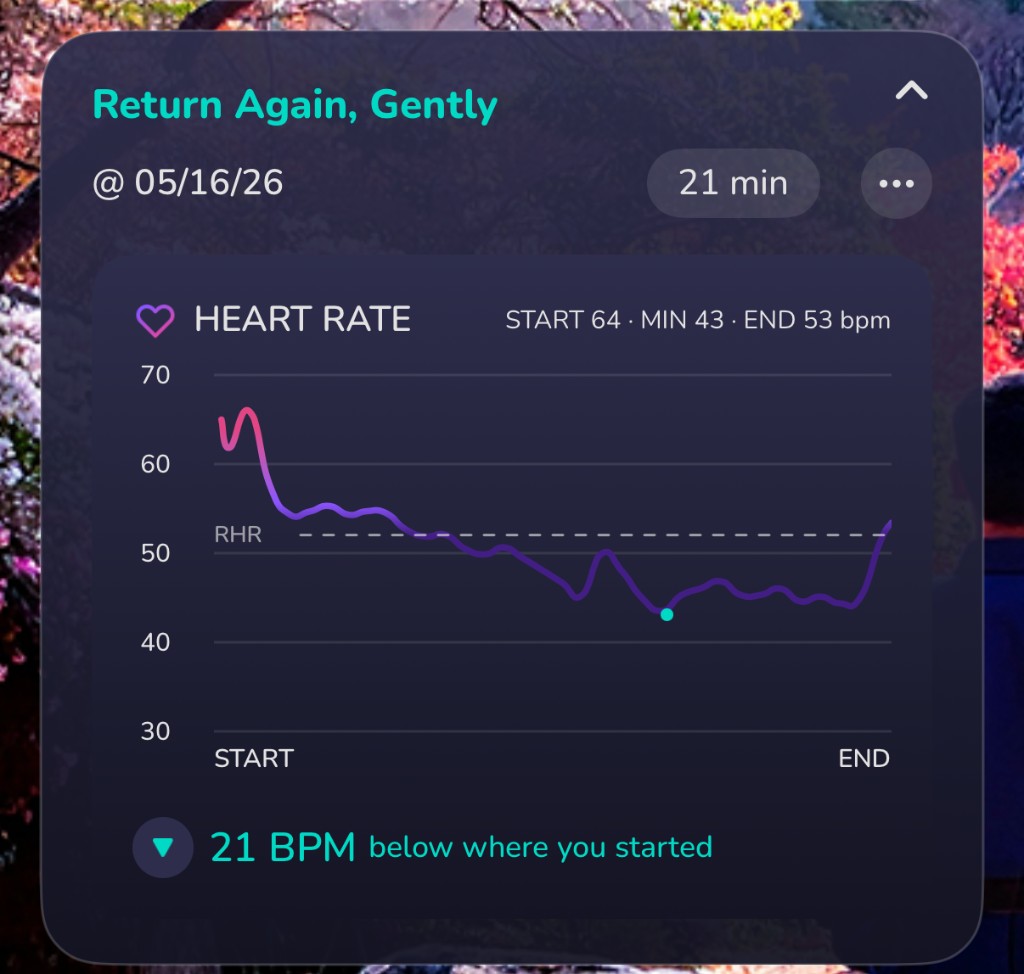
During a recent 21-minute Dojo meditation, my heart rate started at 64 bpm. It dropped to a low of 43 bpm and ended at 53 bpm.
The dotted line on the graph showed my average resting heart rate. For much of the session, my heart rate stayed below that personal baseline.
That does not mean the meditation was “better” in some absolute spiritual sense.
It is one possible sign that my body was settled during that session. It does not diagnose a health state or define meditation quality.
If you want to see how your body responds during practice, try measured meditation on Dojo.
What is resting heart rate?
Resting heart rate is your average heart rate when your body is at rest.
It is not the same as your heart rate during exercise, stress, walking, working, or emotional activation. It is a baseline signal.
In Dojo, we use resting heart rate as a personal reference point. It is not there to judge the meditation or to chase a lower number.
It is there to help you see how your body responds during practice.
What does it mean to go below your resting heart rate?
During meditation, a drop below your usual resting baseline can suggest a more relaxed state. Clinicians sometimes call that a parasympathetic-dominant state.
Your body is moving away from fight-or-flight and toward rest, repair, and recovery.
That can show up as:
- Lower physical tension
- Slower breathing
- Less stress activation
- Better sleep readiness
- More emotional stability
- A quieter internal state
This is one reason heart rate can be useful during meditation. It signals that something real is happening in the body, not only in the mind.
Why the lowest heart rate matters
A simple start-to-end comparison does not always tell the full story.
In this session:
- Start: 64 bpm
- Lowest point: 43 bpm
- End: 53 bpm
If we only looked at the start and end, the session reduced heart rate by 11 bpm. The body also reached 43 bpm, 21 bpm below where the session started.
That lowest point matters because meditation often has a natural return phase. Near the end, the body may begin to wake back up.
Awareness returns, the voice changes, or the session prepares you to continue your day.
The end heart rate is useful. But the lowest heart rate shows the deepest calm reached during the practice.
Why time below resting heart rate matters
Duration matters too.
A quick dip below resting heart rate is interesting. Staying below your resting baseline for several minutes is more telling.
That suggests the body did not just relax for a moment. It entered a more stable calm state and stayed there.
Measured meditation is useful for seeing that pattern.
Instead of asking only, “Did I feel calm?” we can also ask:
- Did my body settle?
- How long did it stay settled?
- Did my heart rate drop below my normal resting baseline?
- Did I recover from stress during the session?
- Did the meditation help my nervous system shift?
These are not perfect measurements, but they are useful signals.
Lower is not always better
A lower heart rate is not automatically better.
Meditation is not a competition to push your heart rate as low as possible. Watch for a low heart rate that comes with any of these:
- Dizziness
- Weakness
- Discomfort
- Chest pain
- Shortness of breath
- Feeling faint
That is not a meditation achievement. It is a reason to stop and pay attention.
The goal is not “lowest possible heart rate.”
The goal is calm, stable, comfortable regulation.
Heart rate is a signal, not a score.
Stop the session if a low heart rate comes with chest pain, fainting, or dizziness. Do the same for unusual shortness of breath or other concerning symptoms.
Then seek medical guidance.
What this tells us about meditation
Meditation is often described as mental training, and it is also nervous system training.
When you practice well, the body changes. The breath changes.
The heart changes. The mind becomes less reactive because the whole system is settling.
That is why Dojo focuses on measurable meditation. Not every experience needs to be quantified.
But feedback can help you trust the practice.
When you can see that your body moved into a calmer state, meditation becomes less abstract. It becomes something you can observe, learn from, and improve over time.
Explore meditation with optional heart rate feedback.
Where meditation is headed
Today, most meditation apps play the same audio file for everyone.
But your body is not the same every day.
Some days you arrive stressed. Some days tired.
Some days restless. Some days already calm.
A meditation system should eventually understand that.
If your heart rate is elevated, the session may need more grounding and breath regulation.
If your body settles quickly, the session may move into deeper focus or visualization.
If your heart rate rises near the end, the session may slow the return.
This is the direction Dojo is building toward. Meditation would adapt to your actual state, not a fixed category like sleep, focus, or stress.
Closing
Your heart rate may drop below your resting baseline during meditation. That can be a sign that your body entered a deeper state of calm.
It does not prove enlightenment, and it does not mean every meditation should look the same. It does show that meditation can create measurable change in the body.
When you can see that change, the practice becomes easier to trust. Measured meditation is not about turning practice into data.
It is about helping you see the change.