A benchmark from reliable Dojo heart-rate sessions. If heart-rate reduction is the signal you care about, session length matters.
Heart rate is not the whole story of meditation.
But it can show one useful thing. It can show whether the body seems to be moving toward a more relaxed state during practice.
A lower heart rate during meditation is often linked with parasympathetic activity. That is the “rest and digest” side of the nervous system.
That does not make the session a verdict on your practice. It simply gives you another way to notice how your body responded.
Short answer: we looked across reliable Dojo sessions with minute-level heart-rate data. If heart rate drops during meditation, that usually takes at least 5 to 6 minutes.
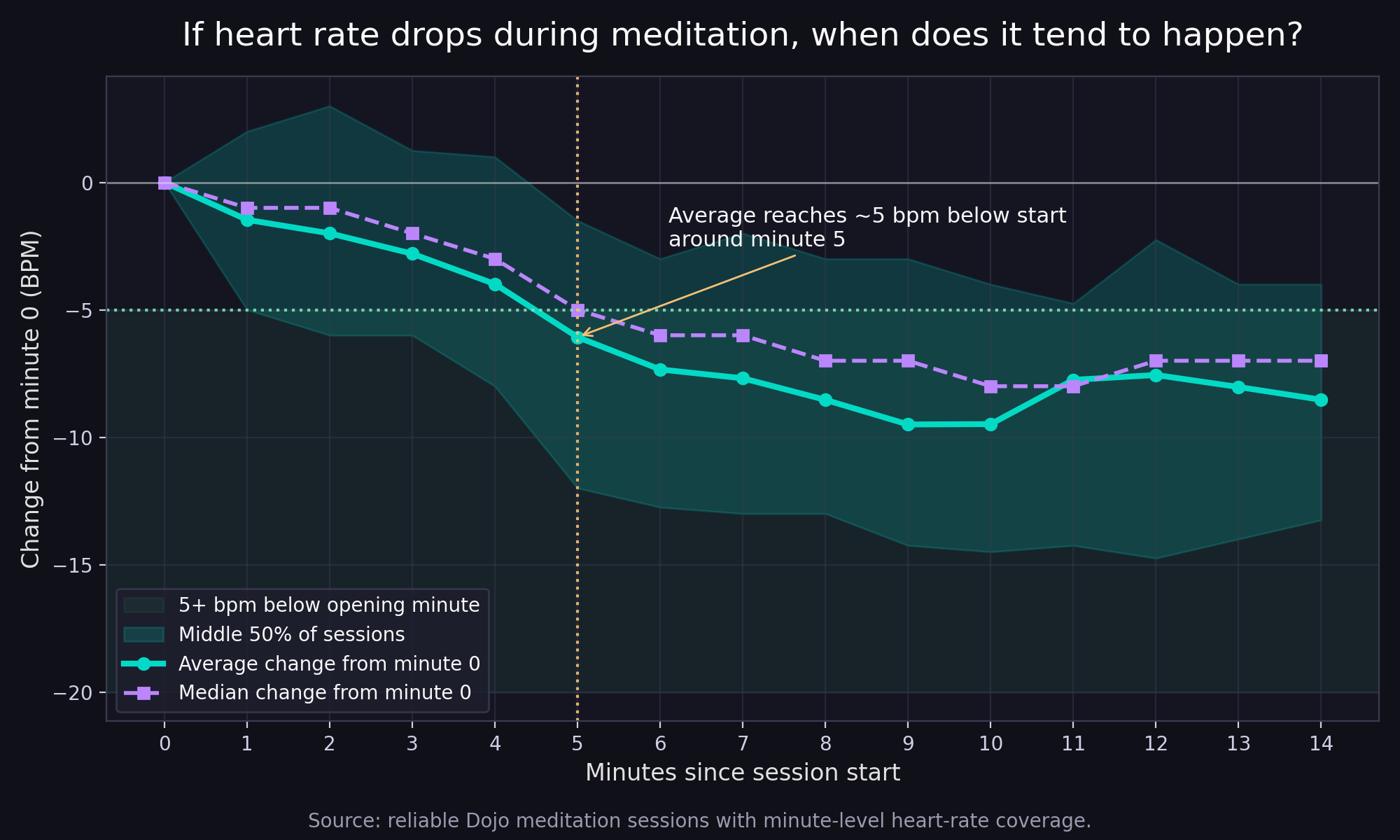
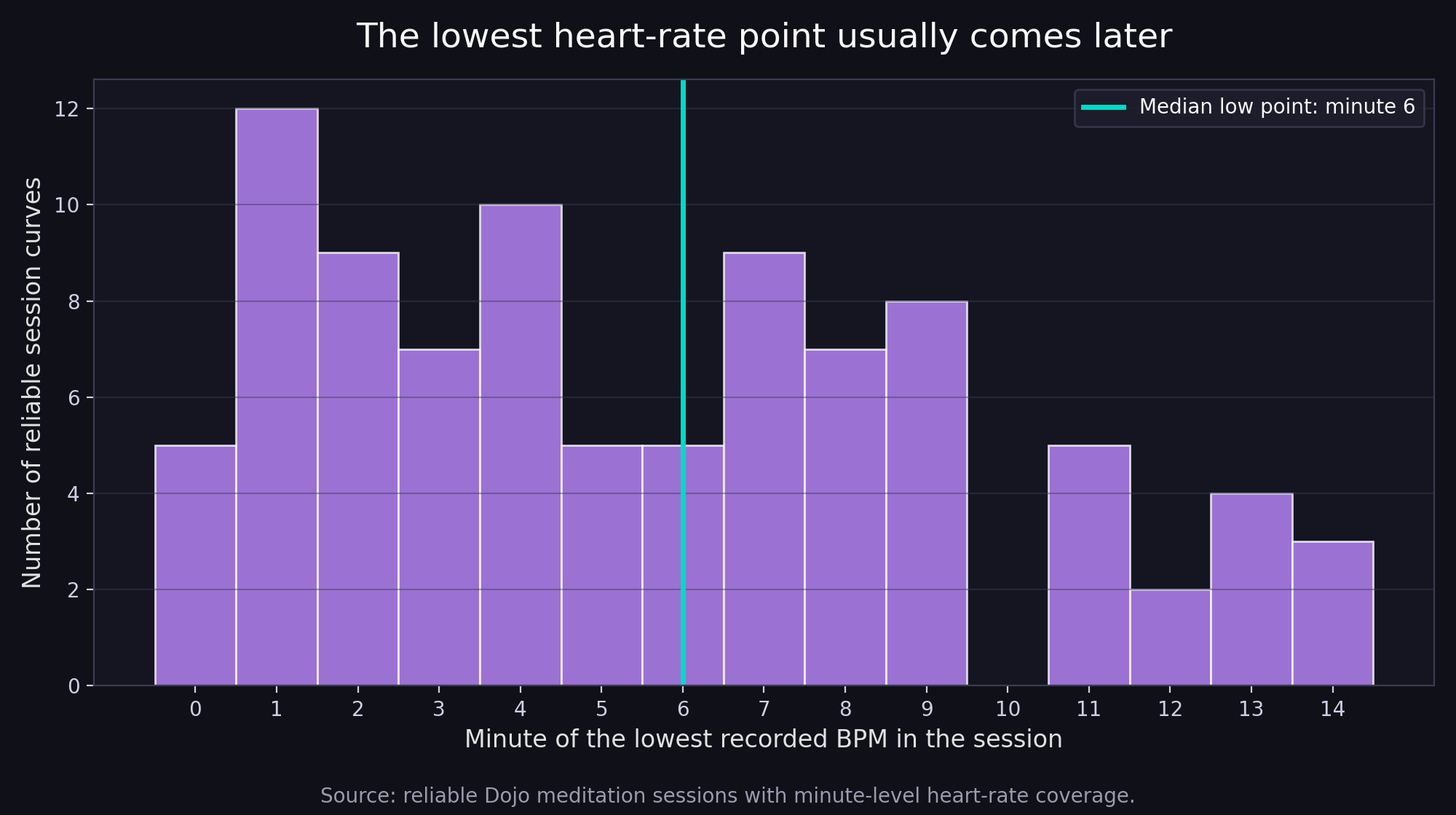
In this benchmark, the average curve reached about 5 bpm below the opening minute around minute 5. The typical lowest point came around minute 6.
The practical takeaway is simple. A very short meditation can help you pause, but it may not give the body much time.
It may not have time to reach a lower-heart-rate state and stay there.
This is a pattern in pooled product data, not a target for your body. Caffeine, illness, movement, device fit, and your starting state can all affect a session graph.
To see how your own heart rate responds during meditation, try measured meditation on Dojo.
What usually happens to heart rate by minute?
For this article, we looked at recent Dojo meditation sessions with reliable minute-by-minute heart-rate coverage.
These were sessions where at least 80% of the planned minutes had a heart-rate sample. We are sharing session-level benchmarks, not private user counts.
| Time in session | Benchmark pattern | How to interpret it |
|---|---|---|
| Minutes 1 to 2 | Small average drift down, roughly 1 to 3 bpm below the opening minute. | The body may still be moving from activity into practice. |
| Minutes 3 to 4 | The downward trend becomes more visible, but many sessions are still settling. | This may be the beginning of a shift, but not always the lower-heart-rate state itself. |
| Minute 5 | The average curve reaches about 5 bpm below the opening minute. | This is the first point where the average session shows a clear relaxation-correlated signal. |
| Minutes 6 to 9 | The curve usually stays lower, and many sessions find their lowest point in this window. | This is where session length starts to matter: you want time in the lower state, not just one low minute. |
When does the lowest heart rate usually happen?
One of the clearest findings is that the lowest heart-rate point is often not at the beginning. In the reliable session curves we studied, the median low point landed around minute 6.
That matters because a five-minute session may end just as the heart-rate curve gets interesting.
Say your goal is to see a lower-heart-rate state. You usually want time for the drop to happen, and then time to stay there.
Is a 5 minute meditation long enough to lower heart rate?
A lower heart rate is not the only aim of meditation.
Many things can affect your heart rate. Sleep, caffeine, stress, alcohol, hydration, and illness all play a part.
So can workout load, posture, sensor quality, and whether you were already calm before you started.
Some practices are meant to relax the body. Others are meant to train attention, reflection, or emotional clarity.
But if the thing you are watching is heart-rate reduction, then session length matters.
In this lens, a 5 minute session can be useful as a pause. But it may be less likely to show lasting parasympathetic activity.
That is because the average drop is just starting to show around that time.
The benchmark can help you read your own graph without judging it:
- Minutes 1 to 2: often only a small change from the opening minute.
- Minutes 3 to 4: the downward trend may begin to show.
- Minutes 5 to 6: the average session reaches a clearer drop.
- After that: longer sessions have more room to spend time in the lower-heart-rate state.
Does a lower heart rate mean parasympathetic activity?
A lower heart rate during meditation can be linked with parasympathetic activity. That is the nervous system pattern often called rest and digest.
This is why heart-rate reduction is often linked with relaxation.
It is still only one signal. Breath, posture, attention, emotional state, and sensor quality all matter.
Dojo uses heart rate as a way to raise awareness, not as a score.
Why this meditation benchmark is useful
A benchmark gives you a reference point without turning meditation into a competition.
Instead of asking whether a session should count, you can ask a more neutral question. How did my body respond over time?
Maybe your heart rate drops quickly. Maybe it takes eight minutes.
Maybe it stays steady because you began already calm. The value is not in chasing a lower number.
The value is in seeing the pattern. You learn what tends to happen in your own nervous system.
How to use this benchmark in your own practice
Start by choosing a session length that gives your body some room. If you usually stop at three minutes, try a little longer.
Then look at your graph after the session, not during it. Watching the number live can pull you out of the practice.
Compare a few sessions over a week or two, rather than judging one. A single graph can be shaped by coffee, a poor night, or a loose strap.
If your curve looks flat, that is not a failure. You may have started calm, or the day may have asked more of your body.
Measured, not scored
Heart rate is not a spiritual score. It cannot tell you whether you were kind, present, wise, or transformed.
It can only show one part of the body’s response.
But that one signal can be useful. It can show whether the body is moving toward a relaxation-correlated state.
And it can help you practice long enough for that shift to emerge and continue.
In Dojo, this is the purpose of measured meditation. It is not about chasing numbers, but about making progress easier to notice.
Frequently asked questions
When does heart rate usually drop during meditation?
In reliable Dojo session curves, heart rate often starts drifting down in the first few minutes. A clearer drop usually appears around minute 5 to 6.
Does a lower heart rate mean relaxation?
It can be a relaxation-correlated signal. A lower heart rate is often linked with parasympathetic activity.
But it should be read as awareness, not as a score.
Is a 5 minute meditation long enough?
A 5 minute session can be useful as a pause. Your goal may be to see and spend time in a lower-heart-rate state.
If so, the benchmark suggests that a longer session may be more useful.